
Pricing & Growth
Scope and SLA boundaries for small MSPs
A practical guide to defining what recurring support includes, what needs separate approval, and how small MSPs should talk about response, resolution, projects, incidents, and vendor work.

Short answer: A scope boundary protects the service promise. It tells the client what is included, what needs approval, and where response targets stop being the same thing as guaranteed resolution.
Scope is the service line
Small MSPs lose margin when every technical problem becomes included support. The problem is rarely one ticket. The problem is a recurring pattern where cleanup, vendor pressure, unsupported systems, after-hours work, and project changes are treated as normal monthly service.
The managed services pricing guide should define the price. This guide defines the line the price is funding.
Use frameworks to clarify responsibility, not to inflate the promise. The NIST Cybersecurity Framework 2.0 separates govern, identify, protect, detect, respond, and recover. A small MSP scope should say which of those functions are included, supported, excluded, or handled only through a separate project.
Response is not resolution
A response target can be useful: the MSP acknowledges the ticket, triages impact, assigns an owner, and starts the next action. Resolution is different. Resolution can depend on client approval, vendor support, hardware, licensing, backups, access, security risk, or a project decision.
The ITIL overview of IT service management is useful vocabulary here because service management is about how work is controlled, not only whether a technician tried hard. For a small MSP, response, priority, ownership, communication, and closure evidence should be written separately from guaranteed resolution.
Do not sell resolution language if the team does not control the variables.
Define what is included
Included recurring service should be written in operational terms:
- supported users, sites, devices, and cloud services;
- normal support channels and support hours;
- patch review, backup monitoring, access review, and monthly evidence;
- queue handling through the small MSP service desk model;
- basic vendor coordination when the vendor path is clear and bounded.
The client should be able to read the scope and know how work enters the queue.
Define what needs approval
Some work may be related to managed service but still outside the recurring fee:
- migrations and major configuration changes;
- cleanup of inherited problems found during onboarding;
- onsite visits outside the plan;
- after-hours support;
- incident response;
- remediation after a security event;
- long vendor escalations where the MSP becomes the project manager.
The CISA Incident Response Plan Basics are a good reference point for this boundary. Incident response has preparation, roles, communication, containment, recovery, and improvement work. Unless that is explicitly sold, it should not be hidden inside normal help desk scope.
Use the client onboarding checklist to identify these items early. Unknown work becomes easier to price when it is written as an exception.
Keep SLA language small enough to operate
For a small MSP, an SLA should be a queue and communication promise before it becomes a heroic resolution promise. Define:
- where requests are accepted;
- when support is available;
- how business impact changes priority;
- what qualifies as emergency work;
- when client or vendor waiting time pauses the MSP action;
- what evidence closes the ticket.
If the team cannot measure it every week, do not make it the headline.
The FTC cybersecurity guidance for small businesses keeps security promises grounded in practical basics such as access, data protection, backups, and response preparation. Those basics still require labor and evidence, so they belong in scope only when the MSP can actually operate them.
Evidence that the boundary worked
Good boundaries leave evidence:
- tickets show owner, priority, next action, and waiting state;
- approved projects are separated from recurring support;
- vendor delays are documented;
- accepted risks are visible in the monthly review;
- invoice exceptions match written approvals.
Use the monthly review checklist to catch scope drift before renewal.
Common mistake
The common mistake is using broad language because it sounds easier to sell. Words like unlimited, complete, guaranteed, and all-inclusive create a promise the team may not be able to operate.
Clear limits are not anti-client. They keep support honest.
When to change level
Change the scope when exceptions repeat, support hours expand informally, vendor coordination consumes senior time, or security work becomes part of the recurring promise. At that point, the contract, price, and service desk model need to move together.
FAQ
What is a scope boundary for a small MSP?
A scope boundary states what the recurring service includes, what needs separate approval, and what evidence proves the MSP did the included work.
Is an SLA the same as a resolution promise?
No. A response target can say when the MSP starts work. Resolution depends on access, vendor response, client decisions, parts, risk, and whether the issue is inside scope.
What should be outside recurring support?
Major remediation, migrations, new projects, unmanaged systems, after-hours work, incident response, and long vendor loops should usually have separate approval or pricing.
When should scope change?
Scope should change when recurring work repeatedly exceeds the priced promise, when client risk changes, or when exceptions become normal operating work.
Related guides

Fixed-fee project pricing for small MSPs
Quote fixed-fee MSP projects from a defined outcome, an internal sell rate, realistic effort, direct costs, and a risk reserve—then keep recurring responsibility in a separate monthly agreement.
Pricing managed services without undercharging
Build a minimum viable price around responsibility, labor, tools, review work, risk buffer, discount boundaries, and the technician time your team must protect.
Small MSP service desk model
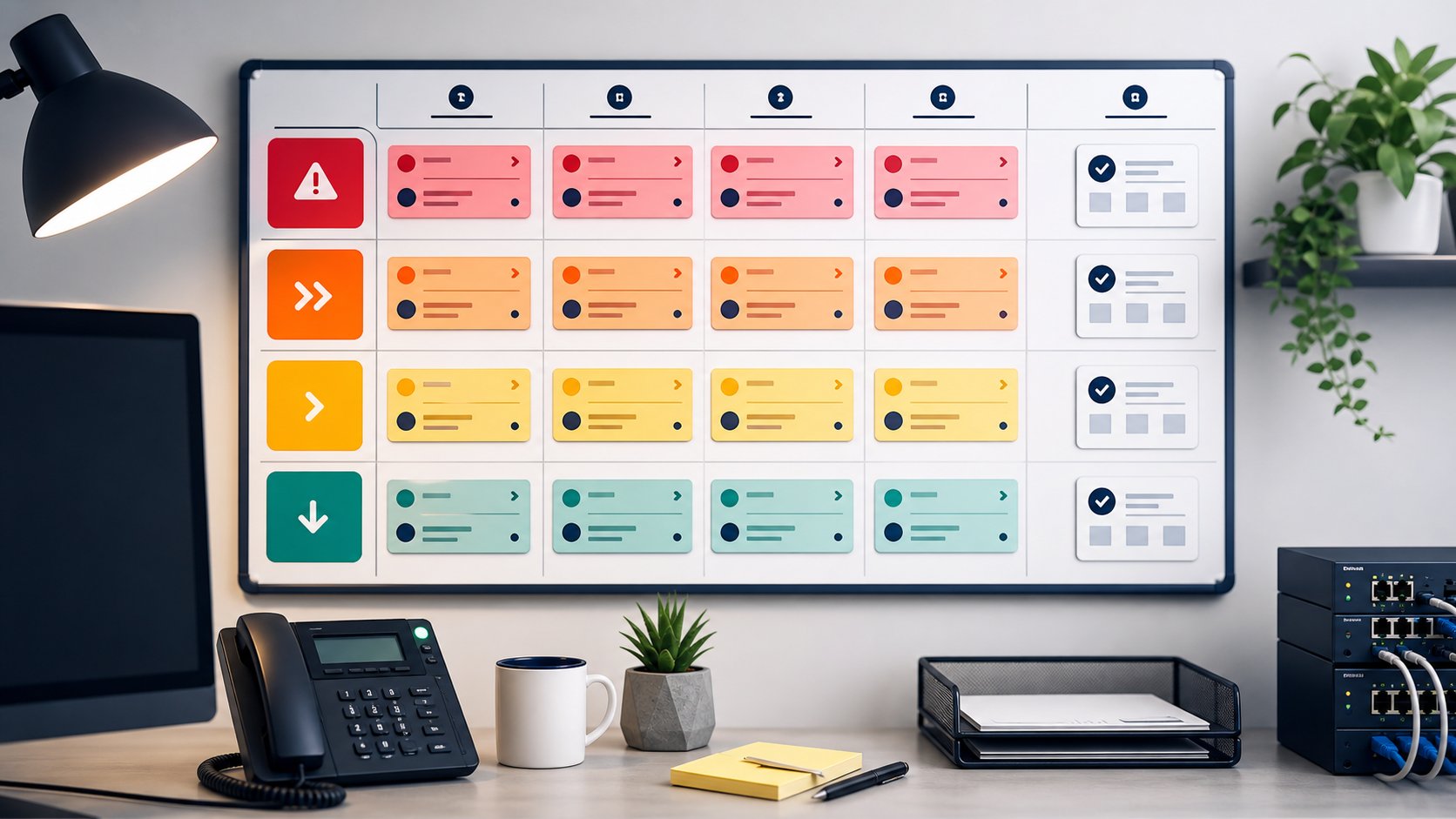
Define intake, priority, next action, escalation, waiting states, closure evidence, and review rhythm before the queue becomes noise.

Client onboarding checklist for small MSPs
Turn a new client from unknown environment into documented, monitored, supported account with clear decisions and exceptions.

MSP monthly review checklist for small teams
Run a useful monthly review without turning it into QBR theater: evidence, exceptions, queue patterns, backup proof, and scope decisions.