
Operations
Small MSP service desk model
A practical service desk model for small MSPs that need disciplined triage, ownership, escalation, and closure evidence without enterprise overhead.
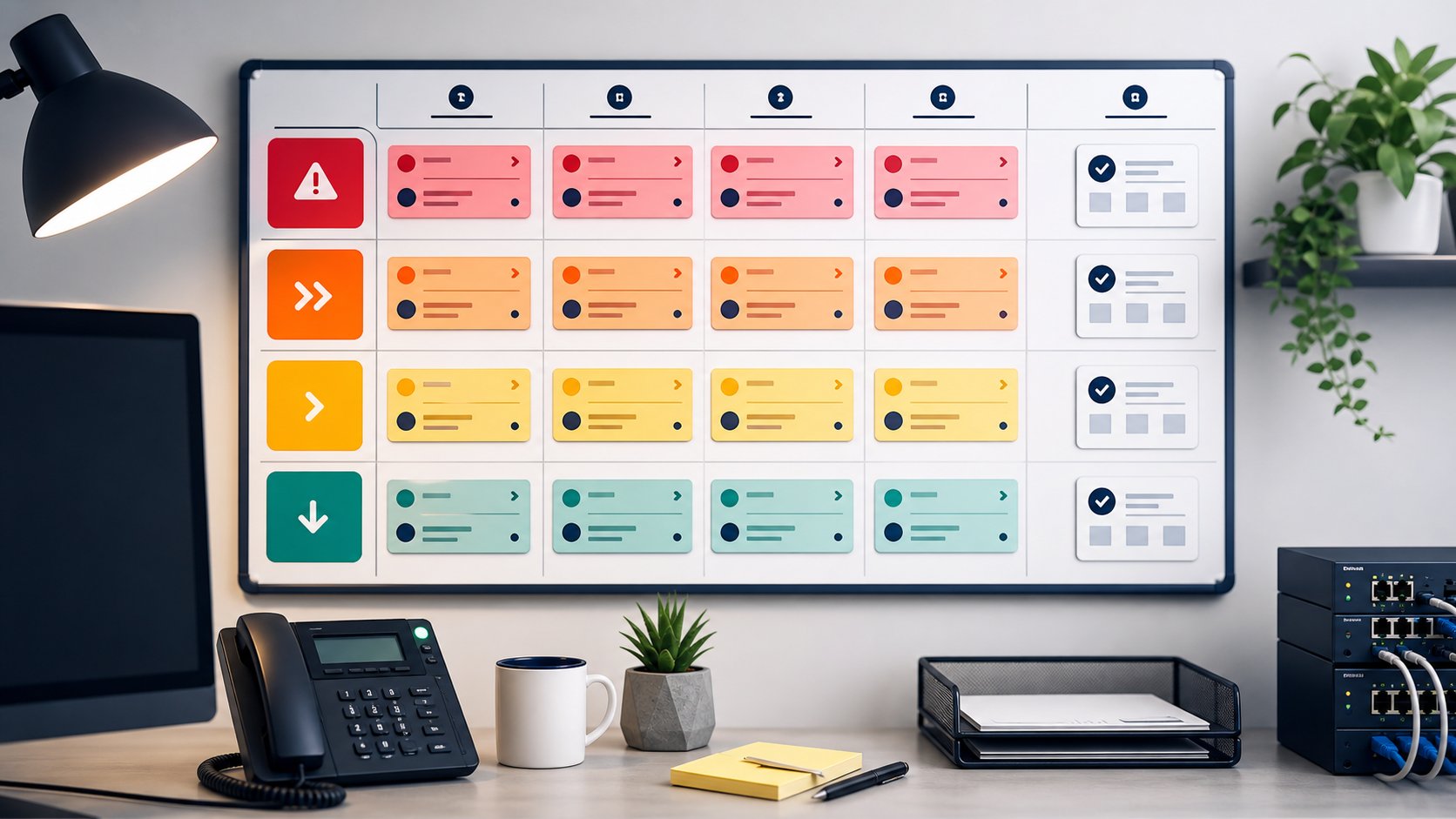
Short answer: A small MSP service desk needs one intake path, a clear owner, a next action, useful priority rules, visible waiting states, escalation boundaries, and closure evidence. The process is strong enough when the queue can explain what happens next without relying on the owner's memory.
A small queue can still be disciplined
A small MSP does not need enterprise process overhead. It needs a ticket flow that answers a few questions before the work disappears into memory, chat, and whoever is loudest.
The service desk model should tell the team:
- What is broken, requested, or changing?
- Who is affected?
- What is the business impact?
- Who owns the next action?
- Who is the ticket waiting on?
- When should it be reviewed again?
- What evidence proves the work is done?
- What should become project work, accepted risk, or a pricing discussion?
If the queue cannot answer those questions, the MSP is not running a service desk. It is running a shared inbox with hope attached.
Keep the model small enough to operate
Use frameworks as guardrails, not as a burden. The NIST Cybersecurity Framework 2.0 is useful because it separates identify, protect, detect, respond, and recover. A service desk touches all of those functions, but a small MSP should translate them into queue behavior: capture the asset, confirm impact, assign ownership, escalate incidents, record evidence, and review recurring risk.
The ITIL view of IT service management can be useful as vocabulary, but do not start with enterprise ceremony. Start with a small set of statuses, priorities, owners, and closure rules that technicians will actually use.

From shared inbox to service desk
The first service desk upgrade is not a platform migration. It is a behavior change.
Move from:
- Requests scattered across email, chat, calls, texts, and memory.
- Tickets with no owner.
- Priorities decided by pressure.
- Vendor follow-ups hidden in someone's inbox.
- Closures that say "done."
- Recurring issues treated as isolated events.
Move to:
- Approved intake channels.
- One current owner per open ticket.
- Priority based on business impact.
- Waiting state visible.
- Next action written down.
- Closure evidence attached.
- Weekly and monthly review of patterns.
The client onboarding checklist should define approved contacts, emergency requesters, supported systems, and ticket channels before the queue is expected to behave.
Intake rules
Pick fewer intake channels than you think you need. Email, portal, and phone for emergencies may be enough at first. The rule is simple: work that is not in the queue does not exist as managed work.
If a request arrives through text, chat, hallway conversation, social DMs, or a direct message to one technician, turn it into a ticket before doing the work. That protects the client and the MSP. The client gets continuity. The MSP gets evidence, history, billing clarity, and a way for another technician to continue.
Create a simple intake rule:
- Normal support enters through email or portal.
- True emergencies can use phone.
- Direct messages are copied into a ticket.
- Vendor emails are attached or summarized in the ticket.
- Internal work gets a ticket if it affects a client promise, asset, tool, or recurring task.
This is not bureaucracy. It is how a small team prevents owner memory from becoming the operating system.
Minimum ticket shape
Every ticket should carry enough context for another technician to continue without calling the first one.
- Client.
- Requester.
- User, asset, service, or location affected.
- One-sentence impact.
- Priority.
- Owner.
- Status.
- Next action.
- Waiting on whom.
- Review time.
- Related vendor, project, or recurring issue.
- Closure notes and evidence.
The "waiting on whom" field matters. Many queues look busy because tickets are open, but nobody knows whether the next move belongs to the MSP, client, vendor, user, or a scheduled review.
Minimum statuses
Use only the statuses your team will actually respect. A small MSP can start with:
- New: needs triage.
- In progress: the MSP owns the next action.
- Waiting on client: the client must answer, approve, schedule, or provide access.
- Waiting on vendor: a third party owns the next response.
- Scheduled: work has an agreed window.
- Blocked by scope: the request is not covered by recurring service.
- Security escalation: the ticket may involve security impact and needs a different path.
- Project candidate: the work should be quoted or planned outside normal support.
- Closed: the work has evidence and the requester knows the outcome.
Do not create ten subtle variants of "pending." The point is to make the next action visible.
Priority model
Keep priority boring and consistent.
- P1: business stopped, broad outage, active security incident, no known workaround, or material data-loss risk.
- P2: critical role, department, site, or revenue workflow blocked.
- P3: normal support issue with a workaround.
- P4: request, scheduled change, question, documentation, access cleanup, or low-risk improvement.
Do not let every executive request become P1. Impact decides priority, not job title alone.
Write the model down in client-facing language. If the client expects a P4 request to interrupt P1 work, the problem is not the queue. The problem is the service boundary.
Security incidents are not normal tickets
Security-related tickets need a separate escalation path. The NIST SP 800-61 Rev. 3 Cybersecurity Incident Response Recommendations and Considerations treats incident response as organized work with preparation, detection, analysis, communication, containment, eradication, recovery, and improvement. A small MSP does not need to copy every enterprise artifact, but it does need to know when a ticket stops being normal support.
Create a simple rule:
- Suspicious login, impossible travel, MFA fatigue, or account takeover signals require security review.
- Ransomware, active malware, data exposure, privilege abuse, or broad compromise signs trigger incident handling.
- Client leadership is contacted when impact, data, legal, insurance, or business continuity may be involved.
- Normal SLA language does not override incident response judgment.
CISA's Incident Response Plan Basics is a useful reference when you need a lightweight incident plan. The service desk does not need to solve the incident alone. It needs to recognize the line and escalate cleanly.
This connects directly to the security baseline for small MSPs. If endpoint alerts, identity alerts, backups, and restore checks are part of the baseline, the service desk needs a ticket pattern for each of them.
Ownership and escalation
Every open ticket needs a current owner. Owner does not mean the person will solve everything. It means one person is responsible for the next movement.
Use a practical escalation model:
- Frontline owns intake, reproduction, user communication, and quick fixes.
- Senior technician owns complex diagnosis, risky changes, vendor pressure, and recurring issues.
- MSP owner or service manager owns client expectation, scope dispute, incident escalation, and pricing boundary.
- Client contact owns approvals, downtime windows, purchase decisions, and accepted risk.
Escalation should move the next action, not just move the ticket. If a technician escalates without impact, evidence, recent steps, and a clear ask, the next person starts from zero.
Vendor case handling
Vendor work needs the same discipline as internal work. Otherwise the service desk turns into a list of open loops nobody owns.
For vendor cases, record:
- Vendor name and case number.
- Portal or support contact.
- Date opened.
- Last response date.
- What the MSP is waiting for.
- What the client needs to know.
- Whether the issue is included support, project work, or vendor-owned risk.
If vendor tickets keep delaying service, feed that evidence into the tool stack selection framework. A vendor relationship is part of the service delivery chain, not just a procurement detail.
Closure rule
A closed ticket should explain:
- What changed?
- What evidence proves it?
- What did the client or user need to know?
- Is there a follow-up risk, project, or recurring issue?
- Should documentation, onboarding notes, monitoring, or the security baseline be updated?
If the note only says "done," the MSP kept the work invisible.
Closure evidence can be simple: screenshot, command output, vendor case number, monitoring recovery, backup success, user confirmation, policy change, or a written client decision. The point is not to create paperwork. The point is to make the work inspectable later.
Queue review rhythm
Small MSPs usually lose control through aging tickets, not ticket volume alone. Add a short review rhythm:
- Daily: P1, P2, waiting-on-client, waiting-on-vendor, security escalation, and tickets with no next action.
- Weekly: recurring issues, stale tickets, noisy alerts, blocked approvals, vendor delays, and small project candidates.
- Monthly: SLA pressure, client exceptions, unmanaged risk, documentation gaps, tool drift, and work that should change pricing.
The FTC cybersecurity guidance for small businesses emphasizes practical preparation and response. In service desk terms, preparation is not abstract: it is knowing which tickets represent risk, which contacts can approve action, and which follow-ups should not be buried.
Use the MSP monthly review checklist when queue patterns reveal scope drift, recurring risk, repeated vendor issues, or work that needs a client decision.
Margin boundary
A service desk model is also a pricing boundary. If every request is treated as included, urgent, and unlimited, the queue will destroy margin before the MSP notices it.
Tie the queue to the managed services pricing guide:
- Included recurring work should have a repeatable ticket pattern.
- Project work should not hide inside support tickets.
- Incidents should not be priced like normal support.
- Unsupported apps should be marked clearly.
- Client-caused delays should not look like MSP failure.
- Repeated noisy alerts should become a tooling or scope decision.
- Vendor coordination should be visible when it becomes recurring labor.
If the price cannot fund the promise, the service desk will absorb the gap.
Common mistake
The common mistake is adding complex workflow before basic ownership exists. Start with intake, priority, owner, next action, waiting state, review time, and closure evidence. Add automation after the team respects the queue.
Automation can make a disciplined queue faster. It cannot make an undisciplined queue clear.
When to change level
Raise the model when tickets age without movement, clients bypass the queue, technicians keep work in chat, vendor cases disappear, security alerts are handled inconsistently, or pricing disputes happen after work is already done.
Also raise the model when the MSP grows past the founder knowing everything. The first service desk process is not for bureaucracy. It is so the next technician can make the right move without reading someone else's mind.
FAQ
What is the minimum service desk model for a small MSP?
Use one intake path, a named owner, a next action, practical priority rules, visible waiting states, escalation boundaries, closure evidence, and a recurring queue review.
How many ticket statuses does a small MSP need?
Use only the statuses that change ownership or action, such as new, in progress, waiting for client, waiting for vendor, scheduled, resolved, and closed.
What is the difference between ticket priority and urgency?
Urgency describes how quickly action is needed. Priority also considers business impact, affected users, security risk, workaround availability, and the service agreement.
When should an MSP escalate a ticket?
Escalate when risk, impact, required authority, technical depth, vendor dependency, time threshold, or scope boundary exceeds what the current owner can safely resolve.
What evidence should close a ticket?
Record the reported issue, work performed, validation result, user or system confirmation when appropriate, remaining risk, and any follow-up owner.
Related guides

PSA implementation and evaluation checklist for small MSPs
Evaluate a PSA by whether a real ticket reaches the right owner, complete time records, a correct invoice, and usable profitability evidence without hidden manual work.

MSP monthly review checklist for small teams
Run a useful monthly review without turning it into QBR theater: evidence, exceptions, queue patterns, backup proof, and scope decisions.
Client onboarding checklist for small MSPs
Turn a new client from unknown environment into documented, monitored, supported account with clear decisions and exceptions.
Pricing managed services without undercharging
Build a minimum viable price around responsibility, labor, tools, review work, risk buffer, discount boundaries, and the technician time your team must protect.

Security baseline for small MSPs
Define the controls, evidence, and client boundaries a small MSP can actually operate each month.